Part of the series Jesus Is Superior, preached at The Valley Remnant Church on November 15, 2026.
We worked on a house in Donora. The contractors had already been through it. The walls were up. The insulation was in. The heat worked. The water ran. The plumbing was right. On the inside, that house was almost finished.
But the outside looked terrible. No siding. Insulation falling off the sides. Weird stuff stapled to it. If you drove past it, you would have thought it was abandoned.
It wasn’t abandoned. The inside had life. The inside had movement. It was filled with people. Laughing, crying, screaming, yelling, all the great things people do. And as the inside kept growing and changing, the outside started to change too. Siding went up. The debris came out of the yard. Flowers were planted. What happened inside finally showed up outside.
That outside would never have changed if there wasn’t first a change within.
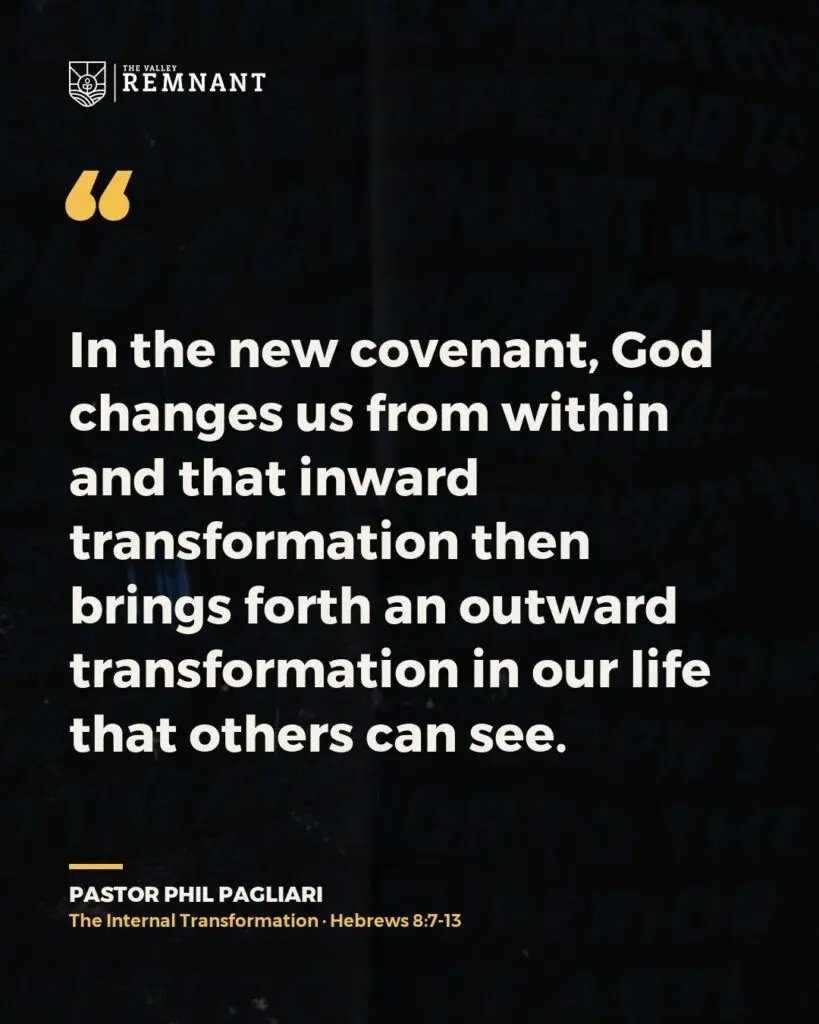
That is what the life of a Christian is like. God changes us from within. And that inward transformation brings an outward transformation that other people can see.
“For if that first covenant had been faultless, there would have been no occasion for a second one. But finding fault with his people, he says: See, the days are coming, says the Lord, when I will make a new covenant with the house of Israel and with the house of Judah, not like the covenant that I made with their ancestors on the day I took them by the hand to lead them out of the land of Egypt. I showed no concern for them, says the Lord, because they did not continue in my covenant. For this is the covenant that I will make with the house of Israel after those days, says the Lord: I will put my laws into their minds and write them on their hearts. I will be their God, and they will be my people. And each person will not teach his fellow citizen, and each his brother or sister, saying, ‘Know the Lord,’ because they will all know me, from the least to the greatest of them. For I will forgive their wrongdoing, and I will never again remember their sins. By saying a new covenant, he has declared that the first is obsolete. And what is obsolete and growing old is about to pass away.”
Hebrews 8:7-13 (CSB)
This isn’t a call to change your clothes. It isn’t a reason to get a new haircut. It isn’t about fixing your outward appearance. It is a reason to rejoice. Rejoice that God has made known to your heart and mind the truth of his Son, the Messiah, the mediator of a better covenant. Rejoice that you no longer have to rely on external things to see God or to know God.
In the new covenant, God has radically transformed the hearts of his people.
1. The External
In the old covenant, God did exactly what he intended to do. He set apart a people for himself, and he commanded obedience from them. But they were not able to fully obey. They kept offering sacrifices, and those sacrifices could never fully remove their sin.
Now hear this clearly. That does not mean the old covenant was bad. It was good. It did exactly what God gave it to do. But it was never supposed to be the end of the story.
The fault was with the people
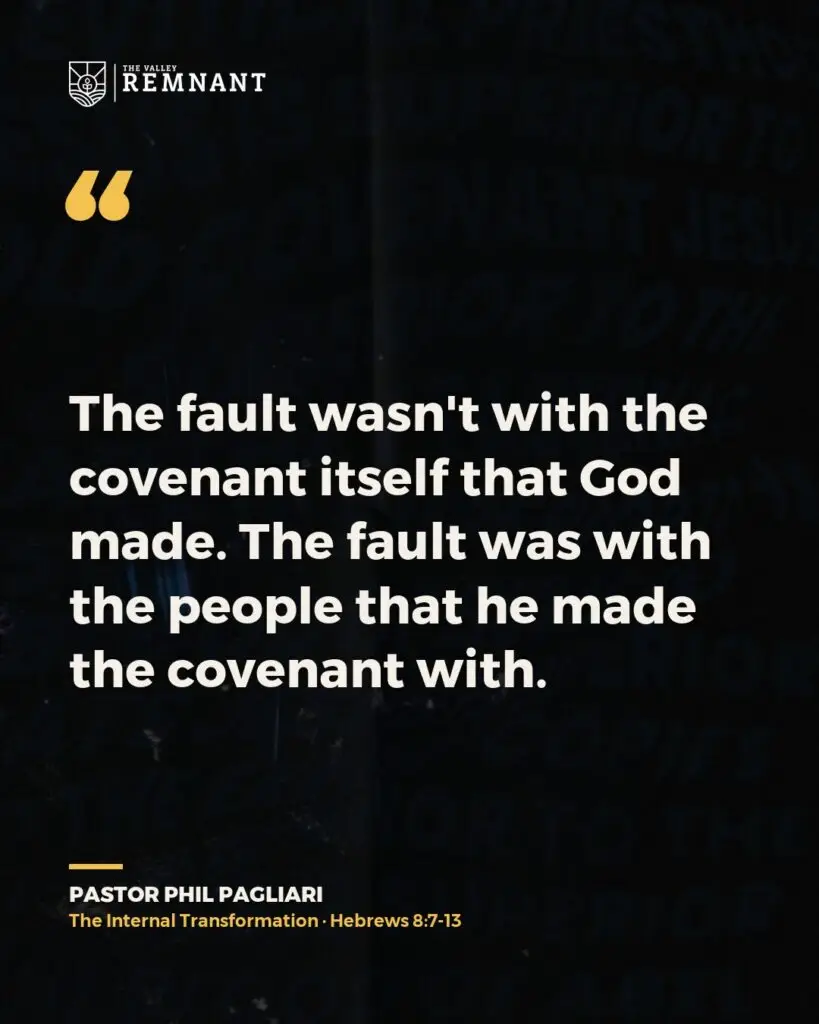
Verse 7 says, “if that first covenant had been faultless, there would have been no occasion for a second one.” But verse 8 tells us where the fault was. “Finding fault with his people.” The fault wasn’t with the covenant God made. The fault was with the people he made it with. God was perfect in making the covenant. The people were imperfect and unable to keep it.
And God knew that. He knew they would not keep it. So he had already promised a new covenant. One that would make his people blameless. One that would remove sin completely. One that would give his people everything they needed.
The writer of Hebrews is quoting Jeremiah 31:31-34, the passage we read together last week. This was not plan B. God didn’t wait for Jesus to show up and then decide to try something new. He had planned it all along.
Tablets of stone
God took Israel by the hand and led them out of Egypt. At Mount Sinai he gave them the covenant through Moses, and he wrote his law on tablets of stone.
But that moral law did not start at Sinai. From creation, the work of the law has been written on the hearts of all men and women (Romans 2:15). Those ten commands on two tablets were a picture of the character of God. There is one God. He does not accept false worship. His name is not to be taken in vain. Love the Lord your God with all your heart, soul, mind, and strength, and love your neighbor as yourself. That is who God is.
And then the old covenant came with a whole external system around it. A tent. A tabernacle where God dwelt with his people in one particular place. Physical sacrifices, over and over, that could never wipe sin away. Priests who died and had to be replaced. Circumcision in the flesh as the sign of belonging to the covenant community. All of it external. All of it showing that God had a particular people for a particular purpose.
They did not continue
The old covenant came with promises, and the land was one of them. But the land depended on obedience. They did not obey. They lost the land, and they were scattered.
Listen to how God put it through Jeremiah:
“However, I did give them this command: ‘Obey me, and then I will be your God, and you will be my people. Follow every way I command you so that it may go well with you.’ Yet they didn’t listen or pay attention but followed their own advice and their own stubborn, evil heart. They went backward and not forward.”
Jeremiah 7:23-24 (CSB)
God sent his prophets to them time and time again. They wouldn’t listen. They became obstinate. They did more evil than their ancestors. They didn’t get better.
And yet God held up his end. He promised David that someone would always sit on the throne. He promised through Jeremiah that he would bring his people back to the land (Jeremiah 30:3), and he did. But even with the land restored, the old covenant still could not fix the heart. A new covenant was always coming.
Obsolete
Remember who first received this letter. These were Hebrews, most likely facing persecution, and some of them wanted to leave the church and go back to the old covenant ways. The writer is pleading with them. God has made a new covenant with you. Not like the old one. Not like the old one.
Verse 13 says, “By saying a new covenant, he has declared that the first is obsolete. And what is obsolete and growing old is about to pass away.”
And what happened a few years later? The temple was destroyed. No more sacrifices. No more temple. No more high priest. Even today there are people holding on to that old covenant system. But it is gone. And they still won’t see what was promised here.
2. The Internal
“I will put my laws into their minds and write them on their hearts” (Hebrews 8:10).
This is something different from being made in God’s image. This is something different from knowing God’s commands and not being able to keep them. When God writes his law on the mind and the heart, it is transformative. It is restorative. He is restoring those who follow Christ back to the image of God.
Outside the new covenant, the law on the heart leads to condemnation. It leads to regret. It leads to frustration. It tells you that you are sinning, and that’s all it can do. But in the new covenant, you receive forgiveness of sins, and you receive the ability to live it out.
I will be their God
The old covenant people had other gods. They worshiped idols. Early on they wanted a king so they could be like the other nations. But in the new covenant, God says there will be no more of that. “I will be their God, and they will be my people.”
They will all know me
“They will all know me, from the least to the greatest of them” (Hebrews 8:11). Every member of the new covenant knows God. You are not a member of the new covenant unless you know God. And that is not head knowledge only. It is an intimate knowledge of who he is, in your mind and in your heart.
This was always the promise. “The LORD your God will circumcise your heart and the hearts of your descendants, and you will love him with all your heart and all your soul so that you will live” (Deuteronomy 30:6). It was never about the external. It was always going to be about the internal.
“I will give them integrity of heart and put a new spirit within them; I will remove their heart of stone from their bodies and give them a heart of flesh.”
Ezekiel 11:19 (CSB)
James Montgomery Boice put it this way: “The Christian is someone who has been born again by the work of the Holy Spirit and who now, as a result of that internal transformation, has his mind set on what the Spirit of God desires.”
New heart, new life
God changes your heart. Your life is transformed. New desires spring up. New activities follow. And new desires and new activities bring new relationships with the people around you. Now you want to be a member of a church. Now you want to know one another, support one another, love one another, because the church is the household of God and his Spirit is in you.
John MacArthur said, “The gospel produces fruit both in the internal transformation of individuals, and also in the external growth of the church.”
Ever since Pentecost in Acts 2, God has put his Spirit inside his people. He fulfilled what he promised in Joel, in Ezekiel, and in Jeremiah. His Spirit no longer dwells in a tabernacle. His Spirit isn’t only dwelling in Christ as he tabernacled among us in his earthly life. His Spirit dwells in us, here and now.
This new covenant is not like the old. It is a new thing. It is a better covenant. It is a superior covenant.
Inside first, then outside
Now let’s not get it twisted. The internal transformation is what starts the new life. But there are also external signs that it has happened. It’s not, “I’m a Christian on the inside, even though I live any type of way and you could never tell from the outside.” No. There will be a difference in the way you conduct yourself.
And the first one is baptism. You believe in God. You have a transformed heart. Out of the obedience that flows from that, the first thing you do is get baptized. You show the world, my insides have been changed. Now watch me change the outside. Watch me wash away the old sin and death I once lived in. Watch me walk in newness of life.
John Stott said, “That God has written his law on our hearts by creation means that we have some knowledge of it; when he writes his law on our hearts in the new creation he also gives us a love for it and the power to obey it.”
The people at Sinai could read the tablets. They understood them. But they didn’t want to obey, and they didn’t have the ability to fully obey. In the new covenant, we have a mediator who did it perfectly for us. He kept everything we cannot keep. He obeyed the law perfectly, and then he died the death of a guilty man though he was innocent. He became a curse for us (Galatians 3:13). He is the eternal Son of God, the God-man, and by his obedience he earned what we needed. We receive his righteousness by faith, and God counts it as if we had kept the law perfectly. That is the confession we hold to as well (1689 London Baptist Confession, chapter 11).
“You show that you are Christ’s letter, delivered by us, not written with ink but with the Spirit of the living God, not on tablets of stone but on tablets of human hearts… He has made us competent to be ministers of a new covenant, not of the letter, but of the Spirit. For the letter kills, but the Spirit gives life.”
2 Corinthians 3:3, 6 (CSB)
Whitewashed tombs
I think part of why we don’t fully appreciate what we have is that we look back at the old covenant and say, look how neat that was. Look at all the things they got to do. Maybe if I did some more things, I’d feel more glorious. More religious. More holy. Dress a certain way. Eat certain things. Do certain things, so everyone can see who I am.
That’s the same mindset the Pharisees had. Jesus called them whitewashed tombs (Matthew 23:27). Fresh, white, clean, and pristine on the outside. Inside, dead men’s bones. No life in them.
So rejoice in what God has given you. He has given you a new heart.
Do I still need a teacher?
Some people read verse 11, “each person will not teach his fellow citizen… saying, ‘Know the Lord,'” and decide they don’t need to listen to a teacher, don’t need to go to church, don’t need anything external because it’s all internal.
That’s not what it means. Everyone truly in the new covenant knows the Lord, so we don’t have to tell one another to know him in that sense. But every one of us in the new covenant is going to encourage, rebuke, correct, and come alongside one another. Weep with those who weep. Rejoice with those who rejoice. Iron sharpens iron. We teach one another. And above all, we grow through our own relationship with God, in his Word and in prayer.
Out of Love, Not Fear
Thomas Schreiner describes “a fundamental incompatibility: whereas the old covenant required Israel’s obedience as a human responsibility, the new covenant makes obedience a divine work, with God writing his law upon hearts.”
Obedience now comes from within. Not out of fear, but out of love. The external obedience came out of fear. Don’t do this, and you’re put outside the camp. Do that, and you’re stoned. But when the law of God is written on a heart of flesh, it brings love for God and love for his people, and you want to obey. It flows naturally and freely.
Be honest. How often do we still measure ourselves by our performance? We look at how we’re living, and we judge by that whether we’re right with God. But we love because he first loved us (1 John 4:19). We don’t obey in order to be righteous. We obey because we’ve been made righteous.
Never again remember
“For I will forgive their wrongdoing, and I will never again remember their sins” (Hebrews 8:12).
If your sins are not forgiven, you will not go to heaven. You have to be holy, blameless, and righteous before God. And we have the one who is. Our high priest didn’t have to offer for his own sins first. He offered himself once for all.
The old covenant worked like a treaty between a king and his people, two parties both bound to keep the terms or the covenant was void. The new covenant is spoken of differently, almost like a will and testament, which takes effect when the one who made it dies (Hebrews 9:16-17). By his death, Christ secured every one of these promises for us. And his resurrection proves it’s true.
“By this will, we have been sanctified through the offering of the body of Jesus Christ once and for all” (Hebrews 10:10).
So we can rejoice. Our sins are forgiven because of the sacrifice Christ made. We can enter God’s presence. We don’t have to fear whether we’ll make it, because he made it. We trust him. He has given us a new heart. So we go to him boldly every day. We thank him for what he’s done. We ask him to keep strengthening us to do what is pleasing in his sight. Not because we need to earn it, but because we love him.
Brothers and sisters, rejoice that God has made known to your hearts and minds the truth of his Son, the Messiah, the mediator of a better covenant.
Watch the sermon on YouTube or listen on SermonAudio. We’d love to see you on the Lord’s Day. Sunday School is at 10:15 AM and worship is at 11:00 AM. Plan your visit.
Grace and Peace,
Pastor Phil Pagliari
Frequently Asked Questions
What does Hebrews 8:7-13 mean?
Hebrews 8:7-13 quotes God’s promise of a new covenant from Jeremiah 31:31-34. The old covenant was good, but the people could not keep it. In the new covenant, mediated by Christ, God writes his law on the hearts of his people, makes them his own, gives every member a true knowledge of him, and forgives their sins forever. The old covenant is now obsolete.
Was the old covenant faulty?
No. The writer says God found fault “with his people” (Hebrews 8:8). The old covenant did what God gave it to do, but it could not change hearts. The problem was never the covenant. It was the people who broke it.
What does it mean that God writes his law on our hearts?
Every person has some knowledge of God’s law by creation (Romans 2:15). In the new covenant, God gives his people a new heart and his Spirit, so they not only know his law but love it and are given power to obey it (Ezekiel 11:19, Ezekiel 36:26-27).
If every believer knows the Lord, do Christians still need teachers and the church?
Yes. Hebrews 8:11 means every true member of the new covenant knows God personally. It does not remove teaching. Believers still encourage, correct, and build one another up in the local church, and grow through Scripture and prayer (Ephesians 4:11-16, Hebrews 10:24-25).